
Every festive season, we clear out the old to welcome the new. We throw out broken furniture, wipe down every surface, and optimize our physical spaces for the year ahead. Yet, in business, we often treat our operational workflows like an overcrowded attic—hoarding legacy software, maintaining multiple brittle vendor contracts, and keeping specialized human "silos" just to sweep up after disconnected systems.
What if this festive season, we applied that same ruthless, transformative spring cleaning to our workflows?
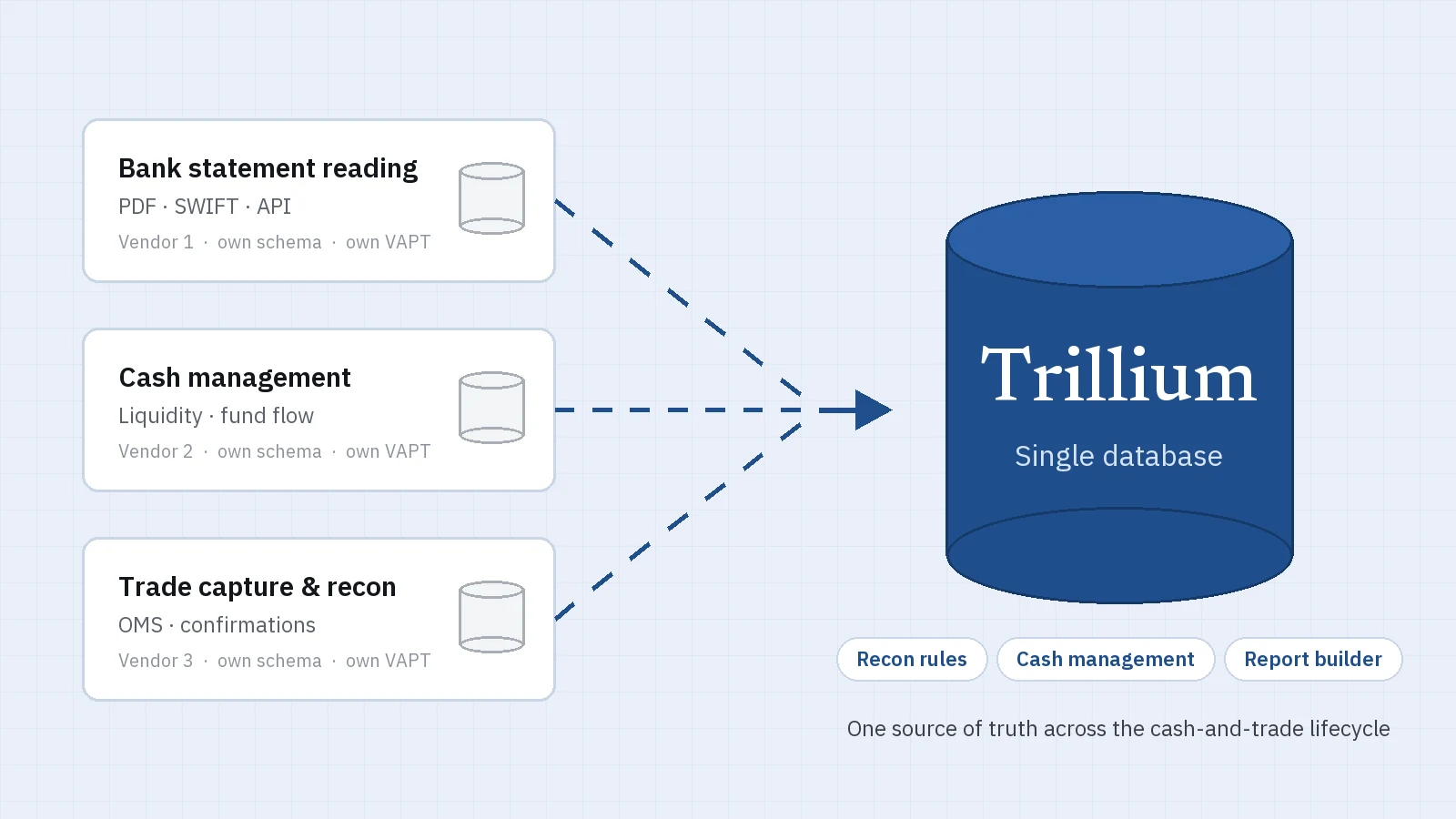
Traditional software was built around functional silos because rigid relational databases and procedural code required narrow, predictable inputs. To solve three distinct problems (reading statements, managing orders, reconciling trades), the industry spawned three different vendors, three different user interfaces, three different integration pipes, three distinct database schemas, and three separate VAPT (Vulnerability Assessment and Penetration Testing) cycles—each demanding its own siloed team of operators.
When you attempt to automate an existing broken workflow with AI, you merely make a slow, manual process faster. But when you rethink the workflow from first principles, AI allows you to collapse multiple vertical point solutions into a unified operational fabric.
1. The Old Paradigm: The Cost of Fragmented Silos
In the traditional stack, the friction wasn't just licensing costs; it was operational entropy:
- Data Fragmentation: Bank statements lived in a PDF/OCR reader; trade orders lived in an OMS; trade recs lived in a reconciliation engine. Data was constantly exported, transformed, and re-imported via fragile ETL pipelines or CSV dumps, creating constant reconciliation breaks.
- The VAPT & Vendor Tax: Every single vendor introduced an independent attack surface. Security teams had to audit three separate codebases, manage three patch schedules, and navigate three licensing renewals.
- Specialized Human Islands: Teams were trained to become human error-checkers for brittle software—manually hunting down why a bank narration didn't match a trade confirmation because a broker deducted a minor clearing fee.
2. Rethinking the Workflow: From Siloed Apps to a Unified Semantic Fabric
If you design the workflow from scratch with native AI architecture, the operational boundaries dissolve. Instead of discrete applications, you build around a Single Source of Truth (SSOT) Canonical Data Model powered by agentic orchestration.
The New Unified Workflow
- Omnichannel Ingestion: Whether a bank statement arrives as an API webhook, a scanned PDF, an encrypted Swift format file, or an email attachment, an LLM-powered ingestion agent can normalize it instantly into your canonical schema without brittle template configurations.
- Autonomous Cross-Domain Context: Rather than treating order management and bank reconciliation as separate universes, a unified agentic layer maintains real-time conversational context across the trade lifecycle. It knows that Trade Order #1243 placed this morning corresponds to the incoming liquidity movement expected on tomorrow's bank statement.
- Probabilistic & Deterministic Matching Engine: Traditional software fails on fuzzy data (e.g., bank text reading "NEFT-HDFC-AXIS0123-ABC CORP" matching against internal trade ref "ABC Capital Trd"). AI bridges deterministic rules (exact ISIN/amount match) with probabilistic semantic reasoning to clear 95% of exceptions instantly, escalating only true anomalies to human operators.
3. How AI Transforms the Vendor and Security Landscape
Consolidating these workflows fundamentally alters your vendor strategy and risk profile:
- Drastic Reduction in Attack Surface (VAPT): Instead of managing multiple disparate third-party applications with unknown code quality, you move toward a lean architecture: either custom-built core intellectual property running on secure enterprise infrastructure or a single, unified foundational platform. Fewer vendors mean fewer entry points for vulnerabilities and a fraction of the annual VAPT overhead.
- From "Software Licensing" to "Process Ownership": You stop buying software licenses for narrow tasks. Instead, you deploy domain-specific AI agents that act as autonomous co-pilots across the entire cash-and-trade lifecycle.
- Evolution of the Human Workforce: Your team shifts from repetitive operational data entry and manual exception-hunting to exception architecture. Staff no longer chase mismatches line by line; they audit the governance rules, train the exception handlers on edge cases, and focus on treasury optimization and exception arbitration.
One Database for Bank, Cash and Trade: Trillium
Our Trillium software comes with a single database for bank account reading and reconciliation, cash management and even trade reading and reconciliation. One can create recon rules, figure out ways to increase the recon percentage and even create your own reports through the report builder.